NY Metro
Emergency Musical Services
Piano Services
Kenneth
A. Farnum, Jr.
(718) 885-2480
(917) 805-4699
(
e-mail:
Ken@NYMetro-EMS.com)
|
|
last updated:
5-08-08
3:30am
|
To schedule a
tuning appointment or a piano
appraisal,
please call Kenneth A. Farnum,
Jr.
Phones: (718)
885-2480 Cell:
(917)
805-4699 Fax:
(718) 885-0774
or
e-mail Ken at: FarnumA440@aol.com
Tuning, voicing, repairs, regulation and piano moving services are
available.
Standard Tuning (no repairs) ranges from $ 90.00 to $150.00 depending on
location (and time of
day).
If the piano is very, very out of tune, a second tuning in a few weeks to a
month
is highly recommended to stabilize the pitch to A= 440
c.p.s.
Some other Piano/Music Websites:
Toni Van Loan(H): (914) 965-5110 -
www.victorianpiano.com/
Joe Hanerfeld (800) 648-8637 -
www.craftsmanpiano.net
(Piano Rentals) Bondy Piano Sales
and Service - http://www.bondypiano.com/rental.htm
PIANO PAGE - Piano Technicians Guild -
Everything about Pianos, Tuning, Service, Repair, History, Find a
Technicia
http://ptg.org/resources-historyOfPianos.php
Click
here: Piano Forums at Piano World: Let's Talk Pianos... Lots of Pianos...
http://www.pianoworld.com/ubb/cgi-bin/ultimatebb.cgi?ubb=get_topic;f=16;t=000040;p=0
 |
Welcome to Vibrationdata Piano
Page
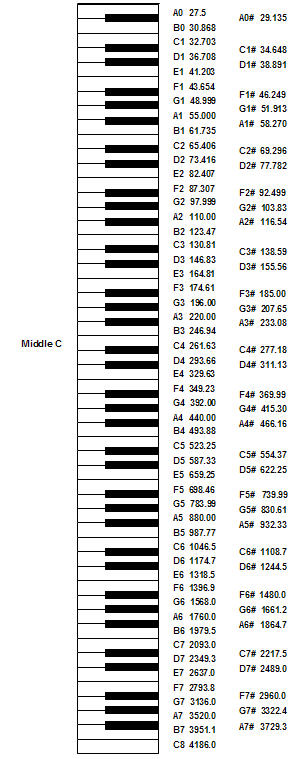
PIANO KEYBOARD
The number beside each key is the fundamental
frequency in units of cycles per seconds, or Hertz.
OCTAVES
For example, the A4 key has a frequency of 440
Hz.
Note that A5 has a frequency of 880 Hz. The A5
key is thus one octave higher than A4 since it has twice the
frequency.
OVERTONES
An overtone is a higher natural frequency for a
given string. The overtones are "harmonic" if each occurs at an
integer multiple of the fundamental frequency.
SOUND FILES
Kawai Piano (not perfectly tuned)
|
Sound Files for Ratios
|
AN INTRODUCTION TO MUSIC THEORY
By Tom Irvine Email:
tomirvine@aol.com
November 24,
2000 ________________________________________________________________________
Historical Background
Pythagoras of Samos was a Greek philosopher and
mathematician, who lived from approximately 560 to 480 BC.
Pythagoras and his followers believed that all relations could be
reduced to numerical relations. This conclusion stemmed from
observations in music, mathematics, and astronomy.
Pythagoras studied the sound produced by
vibrating strings. He subjected two strings to equal tension. He
then divided one string exactly in half. When he plucked each
string, he discovered that the shorter string produced a pitch which
was one octave higher than the longer string. A one-octave
separation occurs when the higher frequency is twice the lower
frequency.
German scientist Hermann Helmholtz (1821-1894)
made further contributions to music theory. Helmholtz wrote "On the
Sensations of Tone" to establish the scientific basis of musical
theory.
Natural Frequencies of
Strings
A note played on a string has a fundamental
frequency, which is its lowest natural frequency. The note also has
overtones at consecutive integer multiples of its fundamental
frequency. Plucking a string thus excites a number of
tones.
Ratios
The theories of Pythagoras and Helmholtz depend
on the frequency ratios shown in Table 1.
Table 1. Standard Frequency
Ratios
Ratio |
Name |
1:1 |
Unison |
1:2 |
Octave |
1:3 |
Twelfth |
2:3 |
Fifth |
3:4 |
Fourth |
4:5 |
Major
Third |
3:5 |
Major
Sixth | |
These ratios apply both to a fundamental
frequency and its overtones, as well as to relationship between
separate keys.
Consonance
Now consider two strings which are plucked
simultaneously. The degree of harmony depends on how the respective
fundamental frequencies and overtones blend together.
Music notes which blend together in a pleasing
manner are called consonances. Notes with a displeasing blend are
dissonances.
Helmholtz gave a more mathematical definition
of these terms:
When two musical tones are sounded at the same
time, their united sound is generally disturbed by the beats of the
upper partials, so that a greater or less part of the whole mass of
sound is broken up into pulses of tone, and the joint effect is
rough. This relation is called Dissonance. But there are certain
determinant ratios between pitch numbers, for which this rule
suffers an exception, and either no beats at all are formed, or at
least only such as have so little intensity that they produce no
unpleasant disturbances of the united sound. These exceptional cases
are called Consonances.
Helmholtz has defined degrees of consonance as
shown in Table 2.
Table 2. Consonances
Degree |
Interval |
Absolute |
Octave, Twelfth, Double
Octave |
Perfect |
Fifth,
Fourth |
Medial |
major Sixth, major
Third |
Imperfect |
minor Sixth, minor
Third | |
For reference, a glossary of musical terms is
given in Appendix A.
Octave
Again, a one-octave separation occurs when the
higher frequency is twice the lower frequency. The octave ratio is
thus 2:1
A note's first overtone is one octave higher
than its fundamental frequency.
Consider a modern piano keyboard. The beginning
key on the left end is an A0 note with a fundamental frequency of
27.5 Hz. A piano key has harmonic overtones at integer multiples of
its fundamental frequency. Thus, the A0 key also produces a tone at
55.0 Hz, which is one octave higher than the fundamental frequency.
The second overtone is at 82.5 Hz.
The twelfth key to the right of A0 is A1,
counting both the black and white keys. The A1 note has a
fundamental frequency of 55.0 Hz. The A1 note is thus one octave
higher than the A0 note, in terms of their respective fundamental
frequencies. In fact, there is a one-octave separation between any
two piano keys which are twelve keys apart.
A pleasing, harmonious sound is produced when
two notes separated by one octave are played simultaneously on a
piano or other musical instrument. Helmholtz calls such a pair an
absolute consonance. Thus, the A0 and A1 keys are an absolute
consonance.
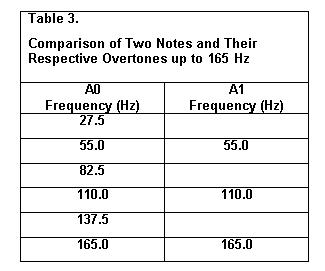
This effect is shown for the A0 note and the A1
note in Table 3.

The overtones of the A1 note thus coincide with
the evenly numbered overtones of the A0 note. Again, these two notes
are separated by one octave.
Hermann Helmholz wrote:
A note accompanied by its Octave consequently
becomes brighter in quality, because the higher upper partial tones
on which brightness of quality depends, are partially reinforced by
the additional Octave.
Twelfth
A twelfth is two notes which form a frequency
ratio of 1:3.
A note's second overtone is a twelfth higher
than its fundamental frequency.
Recall the A0 note with its fundamental
frequency of 27.5 Hz. Its second overtone is 82.5 Hz, which is three
times higher than its fundamental frequency.
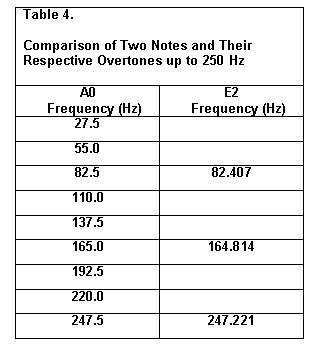
Ideally, there would be a key with a
fundamental frequency of 82.5 Hz. The nearest is the E2 key which
has a fundamental frequency of 82.407 Hz. This frequency
approximately meets the goal. Thus, the E2 key is considered as a
twelfth higher than A0. A comparison is shown in Table
4.

Thus A0 and E2 have three tones very nearly in
common in the frequency domain up to 250 Hz.
Fifth
A fifth is two notes which form a frequency
ratio of 2:3.
A note's second overtone is a fifth higher than
its first overtone .
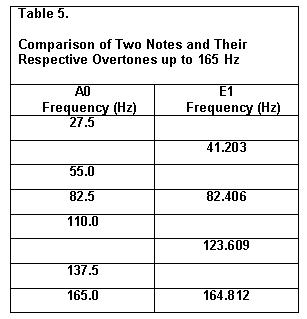
Recall the A0 note with its fundamental
frequency of 27.5 Hz. A fifth higher would be 41.25 Hz. Such a note
does not exist in an exact sense. On the other hand, the E1 note has
a frequency of 41.203 Hz, which is approximately equal to the exact
fifth. Thus, E1 is considered as a fifth higher than A0. A
comparison is shown in Table 5.

Thus, A0 and E1 have two overtones very nearly
in common in the frequency domain up to 165 Hz.
Reference
APPENDIX A
Glossary
Consonance - a simultaneous combination of
sounds conventionally regarded as pleasing.
Dissonance - a simultaneous combination of
sounds conventionally regarded as lacking harmony.
Harmony - a combination of musical considered
to be pleasing.
Harmonic - a tone in the harmonic series of
overtones produced by a fundamental tone.
Harmonic Series - a series of tones consisting
of a fundamental tone and the overtones produced by it, whose
frequencies are at integral multiples of the fundamental
frequency.
Interval - the difference in pitch between two
musical tones
Octave - the interval of eight diatonic degrees
between two tones, one of which has twice the frequency as the
other.
Overtone - a harmonic.
Partial - a harmonic.
Pitch - the frequency of a tone.
Reference: American Heritage Dictionary,
Houghton Mifflin Company, Boston,
1982. |
|
See All 88 Keyboard Frequencies!
1. At what point does a noise become a musical tone?
2.
When do a series of tones become a melody?
3. When do a series of
noises become a percussive tone with no pitch?
4. What is the strongest
natural structure for music?
5. Just as copyrights there are moral
rights, who has the moral right to determine what actually is music
6.
How important or unimportant is the tension and release factor in
music?
Click Here: out of tne
pianos - BEWARE of the SHREDDER!"
http://www.youtube.com/watch?v=PJzG7CSYg3U
Ken Farnum,
Jr. began his first church job during his college years. Taught on the piano
by both mother and grandmother, he was initiated on the organ by his mom,
Judith Farnum, in 1976, taking her position at Our Savior's (R.C.) in The
Bronx. Ken accompanied dozens of popular local groups and singers during his
time at Fordham Preparatory and Fordham University for various events, both
secular and sacred. Almost a dozen years later he fortuitously met his
wife-to-be, Elizabeth Henreckson, while music directing a Cole Porter revue.
Mr. Farnum spends most of his professional time tuning and repairing pianos
for hundreds of customers and prestigious institutions. He also plays for over
a dozen local churches and schools. Ken loves to compose and arrange; he is
founder, arranger and Music Director for SynFauxNY, an electro-classical
synth-keyboard trio based at St. Mary, Star Of The Sea on City Island, NY
where he is organist and music director.
When he finds some extra time, he
runs the NY metro-area foosball (table-soccer) tournament association named NY Metro Foosball.i8.com and runs
around with his wife, Elizabeth
“Note by Note: The Making of Steinway L1037”
follows the painstaking yearlong process of building and fine-tuning a
handmade nine-foot concert grand piano in the Steinway company’s factory
in Astoria, Queens. A paean to the rewards of old-fashioned craftsmanship
in an age of mechanization, the film, directed by Ben Niles, amounts to a
de facto infomercial for Steinway & Sons, the 150-year-old company
that is the biggest name in the high-end piano business. Steinway produces
about 2,000 pianos a year, compared with the approximately 100 a day by
other companies, none of whose names are mentioned.
Among the musicians shown testing and selecting pianos are the jazz
pianists Marcus Roberts, Harry Connick Jr., Bill Charlap, Kenny Barron and
Hank Jones. From the classical side come Lang Lang, Pierre-Laurent Aimard and Hélène Grimaud. Their
appearances are tantamount to testimonials. The completed L1037 is the
piano of Ms. Grimaud’s dreams, and we hear excerpts from her performances
of two pieces by Rachmaninoff.
These magnificent instruments do not come cheap. One is shown in the
Steinway showroom in New York on West 57th Street with a price tag of
$103,400. No wonder a prospective buyer is very particular in choosing a
specific piano. Each handmade instrument has its own personality. Some
yield brighter sounds, while others have deeper, more muted timbres.
The touch also varies considerably. Mr. Connick, who describes himself
as “rather heavy-handed,” prefers “a deep, heavy action,” which means that
notes have to be hit harder than average to make a desired sound. “I like
the piano to play back a little bit,” he says.
Lang Lang compares the best pianos to great actors for their ability to
convey extremes of emotion and attitude. It was the flamboyant pianism in
a Tom and Jerry cartoon, he says, that originally drew him to the
instrument.
Most agree that the individual sound of a handmade piano, as opposed to
one made by machine and tuned by computer, is one of its glories.
“If you do it by computer, it sounds like a synthesizer — like a
machine,” observes a factory specialist, known as a rough tuner.
Each concert Steinway consists of 12,000 parts assembled by as many as
450 people. In addition to a rough tuner, some of the craft experts
interviewed include a case maker, a plate fitter, a grand finisher, a
belly maker, a stringer and a fine tuner. The movie shows them at work,
measuring, fitting, sanding and tightening parts. An artisan with an
experienced hand and a trained ear can sense the effects of minute
adjustments that a machine could never take into account.
As these satisfied workers describe what they do and how their
tradition is handed from generation to generation, you sense that it is
not about to die anytime soon.
NOTE BY NOTE
The Making of Steinway L1037
Opens today in Manhattan.
Produced and directed by Ben Niles; director of photography, Ben Wolf
with Luke Geisbuhler, Mr. Niles and Geoff O’Brien; edited by Purcell
Carson and Mr. O’Brien; released by Plow Productions. At Film Forum, 209 West Houston Street, west of
Avenue of the Americas, South Village. Running time: 81 minutes. This film
is not rated.
Rate and Review has failed to load,
please try again later.
|
Any
comments or additional info for or regarding this site,
please contact Ken, the WebMaster...
Phone: (718)
885-2480 Cell:
(917)
805-4699 Fax:
(718) 885-0774
e-mail:
FarnumA440@aol.com